While traveling in Africa, I often had people calling out to me, “Hey mister, one dollar, one dollar.”

A common scenario, it’s still disturbing to me. Much has been written about this basic phenomenon, but I see it every time I travel internationally: charity never enables individuals to flourish. This isn’t new information. Yet aid continues to be the prevailing model of help today.
Why? Because it’s easy.
We can go in and solve problems. It’s fast. It makes us feel good. And we get to see results. But anyone who looks at macroeconomic data recognizes it’s not a quick fix. Long term, it’s a poverty trap.
On a macro scale, cconomist Dambisa Moyo reports in Dead Aid that Africa has received over $1 trillion in aid in the past 50 years, and in many countries, growth has stagnated–even plummeted. Countries in Sub-Saharan Africa still rank at the bottom of poverty indexes, such as the World Banks’ Doing Business report and the United Nation’s Human Development Index (HDI).
Why has aid not created lasting change in Africa?
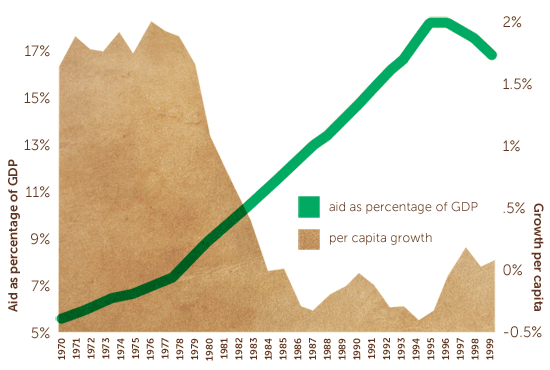
- Dependency. A necessary short-term response to disaster, it has been well researched how aid creates dependency long term. It inhibits people’s desire for enterprise and never enables individuals to realize their God-given potential.
- Band-Aid. Charity is like sticking a Band-Aid on a broken bone. More than a lack of food, shelter, or material comforts, the poor say poverty is hopelessness, despair, and powerlessness. To address poverty, we need to first see poverty with more than just a material definition. See Five Ways the Poor Describe Poverty.
- Handout or Hand up? Ward Brehm, author of White Man Walking said, “The best way to help the poor is to help them not be poor anymore.” That requires wealth generation, not just flinging our leftovers to those in need.
Aid also continues to place the emphasis solely on Africa’s need—rather than its potential.
As I was leaving a community bank (where HOPE clients come together to receive biblically based business training, to repay loans, and to deepen relationships), a group of women called out, “When you come back, we will be even more advanced!” Instead of heads down and hands out, they were clearly on the right track, making progress, and believing the future would be better than today—the very definition of hope.
We need to get beyond pity, and move to real partnership.
To learn more about getting involved in investment initiatives affirming the dignity and enterprise of Africans, read Wealth Creation: Taking China’s Story of Success to Africa.
Graph: *Easterly , W. Can Foreign Aid Buy Growth?, Journal of Economic Perspectives, 17, no.3, (Summer 2003): 23-48.


January 27, 2012
[…] President of the microfinance organization HOPE International, offers some excellent conclusions in this post. Greer concludes the aid model […]
February 21, 2012
[…] Aid is not the Answer […]