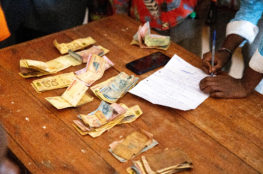
A new movement is underway. Instead of giving those living in poverty a heifer, sponsoring a child, investing in businesses, or building wells, people are giving the financially vulnerable cash—no string attached.

Just a short time after When Helping Hurts and Toxic Charity highlighted how charity can have unintended consequences, it came as a surprise to see how quickly the cash handout model of Give Directly gained attention. I first heard about them on NPR. But then read more in The Economist and Christianity Today.
The more I read, the more I realized this is a more thoughtful approach than it originally sounds. It is not simply a wealthy foreigner reaching into his/her pocket and throwing a couple bucks to the person waiting at the stoplight.
Here’s what I like:
- Data driven: Measuring impact is incredibly difficult to do in a credible and cost-effective way. Give Directly is built on data and they systematically use randomized control groups to measure and monitor impact. Here’s what they found:
- Assets—such as livestock and home repair—increased 58 percent.
- Business income grew 28 percent.
- Gambling, alcohol, and tobacco expenditures did not surge. Other spending did.
- Baseline impact. As a result of Give Directly’s impact research, they have created a baseline of impact. Other programs will need to demonstrate an impact superior to simply providing cash to the families served.
- Leadership. Increasingly, I am as interested in the people as I am in the idea. Although I’ve never met him, founder Paul Niehaus, appears to be a creative and compassionate visionary. While at Harvard, he thoughtfully dialogued about his faith and was contributor to The Harvard Ichthus. Through Give Directly, he is putting his faith in action.
But beyond the positives, I have several lingering questions:
- Long-Term. While the research shows positive initial results, I’m curious to see the long-term impact. While there is initial appreciation, can this approach be sustained? Is this somehow causing people to slowly slip into entitlement as they receive cash virtually falling from the sky? For more, see Cycle of Dependency.
- Social Capital and Distribution. There will never be enough cash transfers to reach every single needy person, so what happens to the people who are not chosen? Does this cause social friction among the haves and the have nots? The market facilitates an exchange where people to buy and sell at a rate determined on perceived value.
- Does it address the underlying cause of poverty? If the problem is only a lack of capital, then giving cash is the solution. But poverty is more than just a lack of material possessions. It’s hopelessness, feelings of helplessness, and voicelessness. (See Five Ways The Poor Define Poverty.) Do people receiving the cash truly feel empowered? Are they dreaming their own dreams?
- Silver Bullet? Every few years, a new concept is announced as THE solution to poverty. And shortly afterwards, it’s rediscovered that there simply is no such thing as a silver bullet. I hope the initial enthusiasm does not oversell impact or recognize the critical partnerships required among health care, financial services, investment, mental health, and business. It’s only with a concerted effort that we see solutions to the complexity of poverty.
- Does this feed into a “Western Savior” complex? Aid places the giver in a position of power. And it diminishes the role of the receiver. Again, the books Toxic Charity and When Helping Hurts demonstrate that our best intentions can unintentionally harm.
- Jobs. The proven pathway out of poverty is job creation. Beyond grants, are there ways to help families gain access to savings accounts, markets and other tools entrepreneurs need to expand a business? Africa is an economic frontier and I hope this model does not miss the positive momentum we are seeing in transitioning from aid to enterprise (see www.povertycure.org).
Perhaps fundamentally, the question is whether or not it is acceptable to give expecting to receive something in return.
In Scripture, we see a number of intriguing examples, including the early Church. While known for spontaneous giving—“They sold property and possessions to give to anyone who had need” (Acts 2:45)—they also gave selectively.
For example, widows had to meet specific requirements to receive charity, wrote Paul. Being “over sixty,” “known for … good deeds,” as well as “showing hospitality” were just a few stipulations (1 Timothy 5:10).
In effect, it was conditional giving.
The financially vulnerable understand their needs better than we do. Let’s empower them to make their own choices. But let’s not say it is intrinsically immoral to give expecting something in return: Sponsoring a child with the hope they attend school, providing a loan with expectation of a business investment and repayment, or giving a cow with the belief that offspring will be given to others.
Rather it’s good stewardship.


January 23, 2014
I thought this evaluation from the World Bank on Give Directly was useful. http://blogs.worldbank.org/impactevaluations/some-thoughts-give-directly-impact-evaluation
January 23, 2014
Thanks Fred. I appreciated the World Bank response and comments on self-reporting. Once again, this demonstrates that credible and cost effective impact assessment is challenging.
January 29, 2014
[…] Whether the new trend of giving unconditional cash grants to poor people is a good idea is discussed by Peter Greer in his post Is Giving Cash to People in Poverty a Good Investment? […]