
When James was just eleven years old, he was diagnosed with cancer. This diagnosis is devastating regardless of country or context, but it brings added challenges when it comes in a nation already experiencing poverty. Of the 300,000 children and adolescents diagnosed with cancer every year, about 80% of them live in low- and middle-income countries like James’ home country of Rwanda. And in these countries, cure rates are estimated at just 20%.
Living in rural Rwanda, James’ parents were convinced that the future was dismal for their son. After doctors amputated James’ leg to remove the cancer, James remembers his parents saying, “We will have to help our son forever. He’ll never be able to stand on his own.”
His parents were not alone in their perceptions. One day, a man saw James walking with crutches and tossed him a coin. In that moment, James made a promise to himself: “I am not a beggar. I will not beg.” James used the coin to buy bananas from a nearby stand and distributed the fruit to the other kids nearby.
As he got older and began looking for an investment to start a business, James found that few people were willing to see beyond his physical disability. Bank after bank turned him away … until he approached Urwego Bank, a HOPE-managed microfinance institution in Rwanda. Urwego took a chance on James and gave him a small loan to start his business.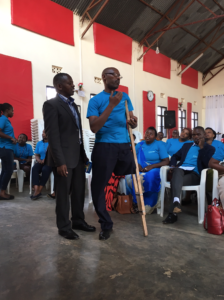
Today, James is married with kids and runs a small business that sells materials used to manufacture shoes and clothes. He shared his gratitude not only for the investment capital he received, but also for the community of entrepreneurs who supported and prayed for each other. He shared, “Before I had no house, now I own a house. Before I had no land, now I have land.” Beaming proudly, he noted that he now can cover his children’s school fees without assistance. “I thank God!” he concluded.
As I listened to James share his story of courage and faith, I was reminded of the power of a simple invitation. To look beyond obstacles and invest in a person’s God-given potential. To say yes when others say no. And I wonder how many times we miss out on opportunities to invite others in.
A Call to Invite
When Jesus was invited to eat at the house of a prominent Pharisee, he looked around the table full of renowned experts of the law and told his host, “When you give a luncheon or dinner, do not invite your friends, your brothers or sisters, your relatives, or your rich neighbors; if you do, they may invite you back and so you will be repaid. But when you give a banquet, invite the poor, the crippled, the lame, the blind, and you will be blessed. Although they cannot repay you, you will be repaid at the resurrection of the righteous” (Luke 14:12-14).
It’s easy to love people who are like us or are close to us. It’s easy to love people who can repay our hospitality. But the Gospel never seems to settle for what’s easy or comfortable. Rather, it confronts our risk assessments and occasionally ruffles our ironed tablecloths. It invites us to actively look for people who might feel alienated or alone, people who may have been defined and excluded because of their circumstances.
What if we were to follow Christ’s example to love without any expectation of reciprocity? Jesus flung wide the doors to His banquet and invites each of us to have a seat at His table. What if we tried to do the same?
This Thanksgiving, who could we welcome to our table?


April 12, 2020
Well written post.