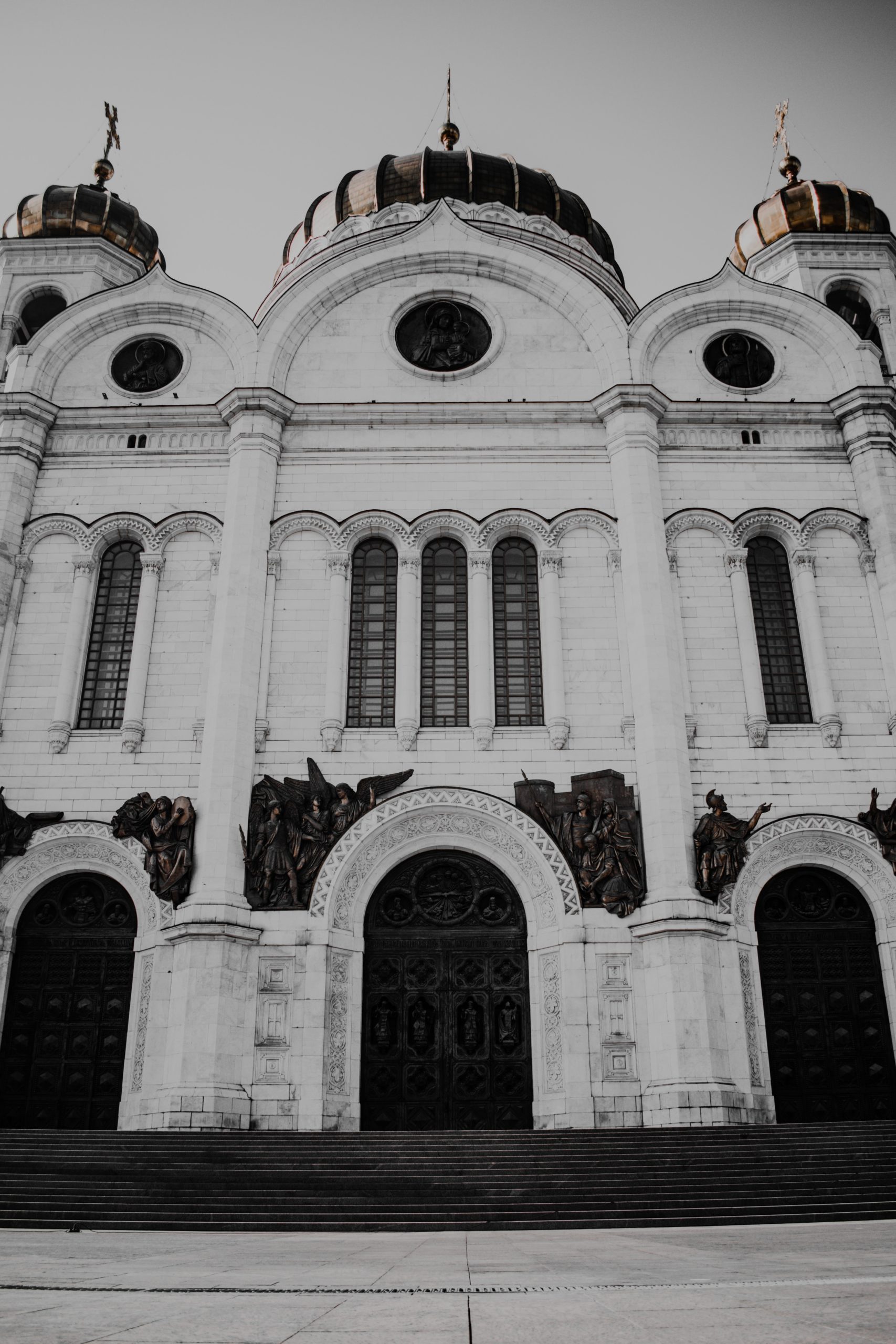
On March 15, Russian police detained Anastasia Parshkova, a young woman who stood outside Moscow’s main Orthodox cathedral holding a sign that read, “Thou shalt not kill.” Those words, straight from the biblical Ten Commandments, represented one reason why people of faith might be opposed to the Russian government’s invasion of Ukraine on February 24. It’s difficult to construe Russia’s unprovoked attacks against Ukraine as just or unavoidable. Yet among Russian Orthodox Church leaders, Parshkova would find little support. In April, Time magazine reported that although some brave priests had spoken out, not a single senior cleric inside Russia had expressed dissent against the war. Rather, the leader of the Russian Orthodox Church, Patriarch Kirill, has staunchly defended and blessed Russia’s military exploits.
So much about Russia’s aggression toward Ukraine has been heartbreaking—from the violence against civilians to the separation of families—but, for me, one of the most gut-wrenching aspects has been watching the response of the Russian Orthodox Church. In a denomination with over 40,000 full-time clerics, fewer than 300 priests and deacons have signed an open letter, which has been circulating since March, calling for peace and reconciliation. They represent not even one percent of Russian Orthodox clergy.
Where are the others?
Some are silent. Others are actively advancing and promoting a nationalistic agenda within their congregations. Some have painted Putin as a hero—even a saint—even though his actions are wildly out of step with the example of Jesus. The Russian Orthodox Church has lost the heart and soul of what it means to follow Jesus. They have failed to be salt and light, a moral voice, or a compass pointing their leaders and followers alike to true north. Religion has been conscripted by the State. This unholy alliance never seems to end well.
The Gospel of Matthew teaches, “No one can serve two masters.” There is no reading of Scripture in which allegiance to God is at the same level of allegiance to a nation. When Pilate wondered if Jesus had come to usurp political power, He responded, “My kingdom is not of this world.” Jesus was here to establish a Kingdom, not to overthrow an empire, and the goal for His followers remains the same.
The Russian Orthodox Church has subordinated its God-given calling to the whims of a political leader and a state’s agenda. The church has been used as a political pawn of their president rather than an agent of change representing their King. Its credibility has been lost.
Jesus taught His disciples to pray, “May your Kingdom come, may your will be done on earth as in heaven.” May God’s Kingdom reign over Russia—and may our first and highest allegiance always be to our King and His Kingdom, not empires.



November 28, 2022
Peter, I’m deeply saddened by this as well. I’m Eastern Orthodox myself, so for me the wrestling you talk about isn’t just with some other branch of Christianity but my own. I think you’re still missing a lot of context here, though.
From everything I’ve read, the Russian people at large are still getting the vast majority of their information from a state-controlled media. It’s hard to resist something that you don’t even know about. The letter you linked to was shared within days of the invasion. Many Russian Orthodox leaders outside of Russia have spoken out. As with the Russian public at large, I think in many cases priests and pastors in Russia genuinely don’t know what’s happening in Ukraine. And many have questioned it, and it’s not solely a Russian Orthodox challenge: https://www.forum18.org/archive.php?article_id=2763. But these leaders have to consider these decisions gravely–and like a parent making decisions that affect not only themselves but their children: many congregations, whether Christian, Jewish, or Muslim, now find themselves without a spiritual leader because their leaders had to leave Russia. I also read something of Patriarch Kirill being questioned on his stance, and he seemed genuinely confused by the question and his assistants clarified that the West had been taking his statements out of context. I don’t know the man’s heart, but you have to assume that even if he had full integrity, decades of state-controlled media and information would skew his thinking significantly.
I also think it’s unfair to paint with such a broad brush. It would be easy to take your statement and simply change the name: “Others are actively advancing and promoting a nationalistic agenda within their congregations. Some have painted *Trump* as a hero—even a saint—even though his actions are wildly out of step with the example of Jesus”. I think you and I both lament this reality, but I don’t think either of us would follow it with the hyper-generalized statement “The American Church has lost the heart and soul of what it means to follow Jesus.” Please consider the many faithful Christians in Russia, both leaders and laity, still seeking to serve Christ. Let’s pray for them that they would know truth and that they would have wisdom and discernment about how to follow Christ in the context they’re in.
May God bring peace to the world and may His glory be known through His people.
December 1, 2022
Chris, thank you for your thoughtful comment and for sharing your perspective on the many layers of context that complicate this picture. Very helpful and important. Perhaps as a global Church, we have missed an opportunity to stand in solidarity with those forced to pay fines or endure hardship for speaking truth in Russia. I also agree and join with you in lament that this is not a problem unique to the Russian Orthodox Church – and was certainly thinking about how this same standard can be applied to churches within the United States or elsewhere: When we give our greatest allegiance to a political leader or a political agenda, we have lost the heart and soul of what it means to follow Jesus. I echo your words, “May God bring peace to the world and may His glory be known through His people,” and I join you in prayer that believers in Russia and beyond would have wisdom to follow Christ in the context they’re in. I’d like to continue the conversation next time we’re together.